Sent March 16, 2026
Dear Editor,
As a party having worked for decades investigating the bush meat and the trade in wildlife , I have some feedback to your recent story in the NYT magazine – The Quest to save One Baby Gorilla From an Uncertain Fate.
Efforts to find an email address for Yudhijit Bhattacharjee, the author, failed and we would appreciate you forwarding this email to him.
1. I have worked in Central and West Africa for roughly 15 years investigating the bushmeat trade. One outcome of that work was the book Eating Apes (see link below), published by the University of California Press, which received considerable attention at the time. This was followed by a photographic “coffee-table style” exposé named Consuming Nature (see link to scanned version below). For obvious reasons, this expose was not a commercial proposition and was instead distributed in range countries to policymakers for educational purposes. Jacques Chirac, the French President at the time, received a copy from Greenpeace and later wrote a letter of thanks and appreciation, stating that he would ensure it reached every head of state attending the upcoming Francophone summit.
2. When Bili first arrived at Pandrillus, there was lobbying to move her to a genuine gorilla sanctuary, with proper gorilla companions, so she could relearn how to be a gorilla. Under Article VIII of the CITES Convention, illegally trafficked CITES Appendix I species should be offered for repatriation to their country of origin. This proposal was not well received in Cameroon. One argument was that Bili’s origin was unclear, and therefore it was uncertain whether a suitable facility existed in the relevant range country—already concluding, conveniently, that she was not a Nigerian Cross River gorilla.
We addressed this by obtaining a hair samples and conducting DNA analysis. The results matched most closely with a museum gorilla hunted in the Mouloundou area of Cameroon. I was therefore glad to see that your piece acknowledges that Pandrillus now accepts Bili originated in Cameroon. Cameroon has two gorilla sanctuaries housing the same subspecies. Neighboring Gabon and Congo-Brazzaville each have one as well, and both have gone further by rewilding some individuals. This raises an obvious question: why is Bili still confined in a cage with three chimpanzees in Nigeria?
3. The Jordanian ape broker has been active for years and appears well established within the Central African wildlife trafficking community. He regularly offers apes as a middleman, earning commissions and operating under a modus operandi that has clearly worked—evidenced by the fact that he remains active to this day.
4. Having spent many months in logging and hunting camps across Central and West Africa, as documented in the above-mentioned books, I seriously doubt that Bili was captured by hunters “working at the direction of traffickers.” The depicted hunting scene is not representative of reality. I never encountered hunting parties of five fully armed men. Typically, one or two hunters go out together; sharing meat among five makes little sense, even when hunting in elephants with specialized rifles – of which there are not many but there are tons of shotguns and corresponding cartridges available in the region.
I documented one – very likely typical – case in which a gorilla family was killed, including two babies (see link to images attached ). Larger mammals are generally hunted with Chevrotine shotgun cartridges, which release 69 lead balls. With such a spray pattern, it is impossible to target only a mother without risking injury to infants. In the documented case, I was staying in a hunting camp linked to a larger logging operation. During breakfast, a single hunter came running asking for porters because he had “a lot of meat.” I followed, filmed, photographed, and later interviewed him. The story aired on CNN (see link below). According to the hunter, the silverback was shot first but escaped; he then killed three females and, unintentionally, two babies.
5. A few years later, I spoke with DRC government officials at a CITES meeting in Bangkok. They were planning onward travel to China, where there was an order for one of their gorilla subspecies. They were confident this could be done under the CITES Purpose Code for Scientific Research—despite the fact that no research would have been involved and the transaction was clearly commercial.
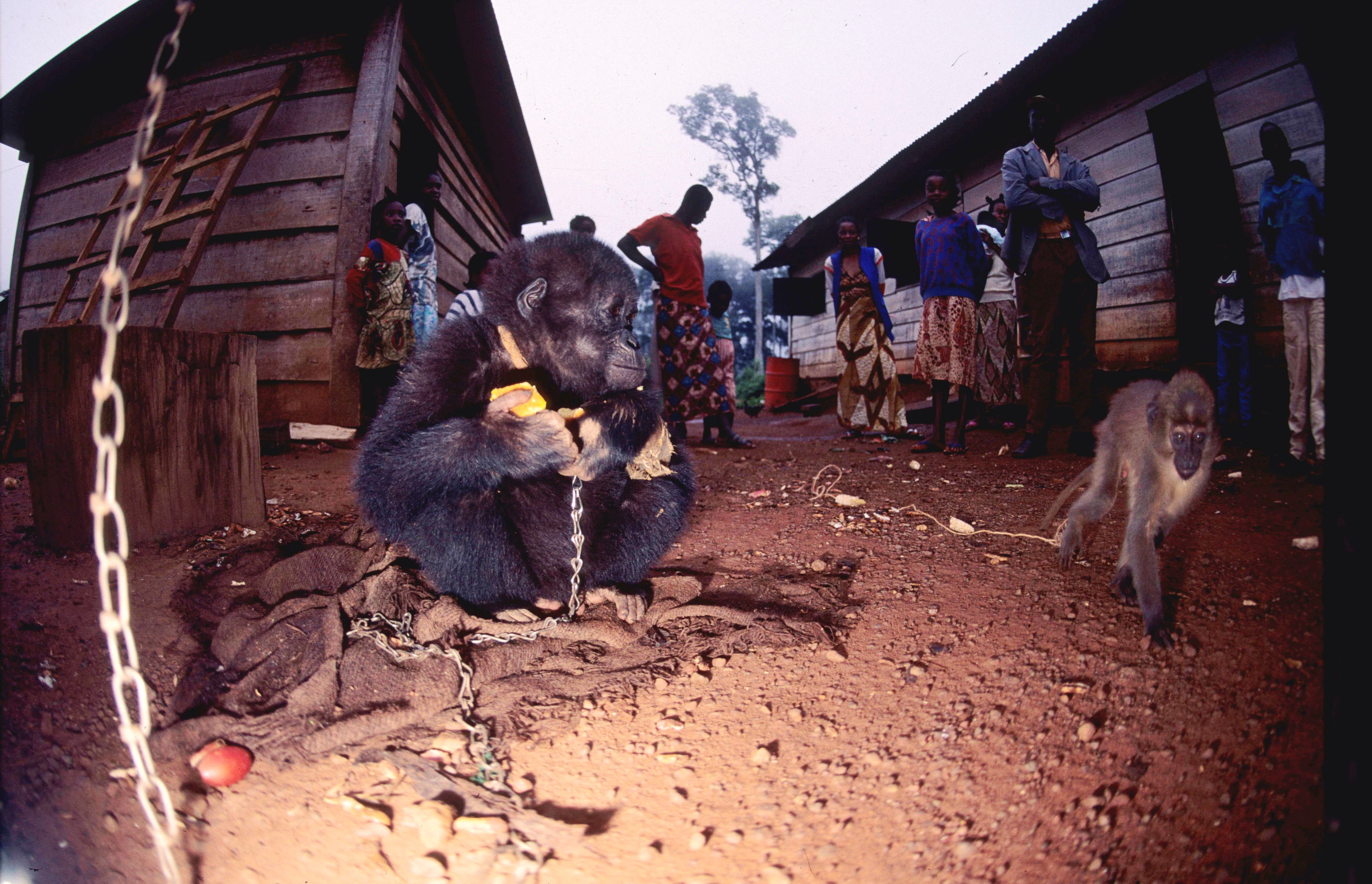
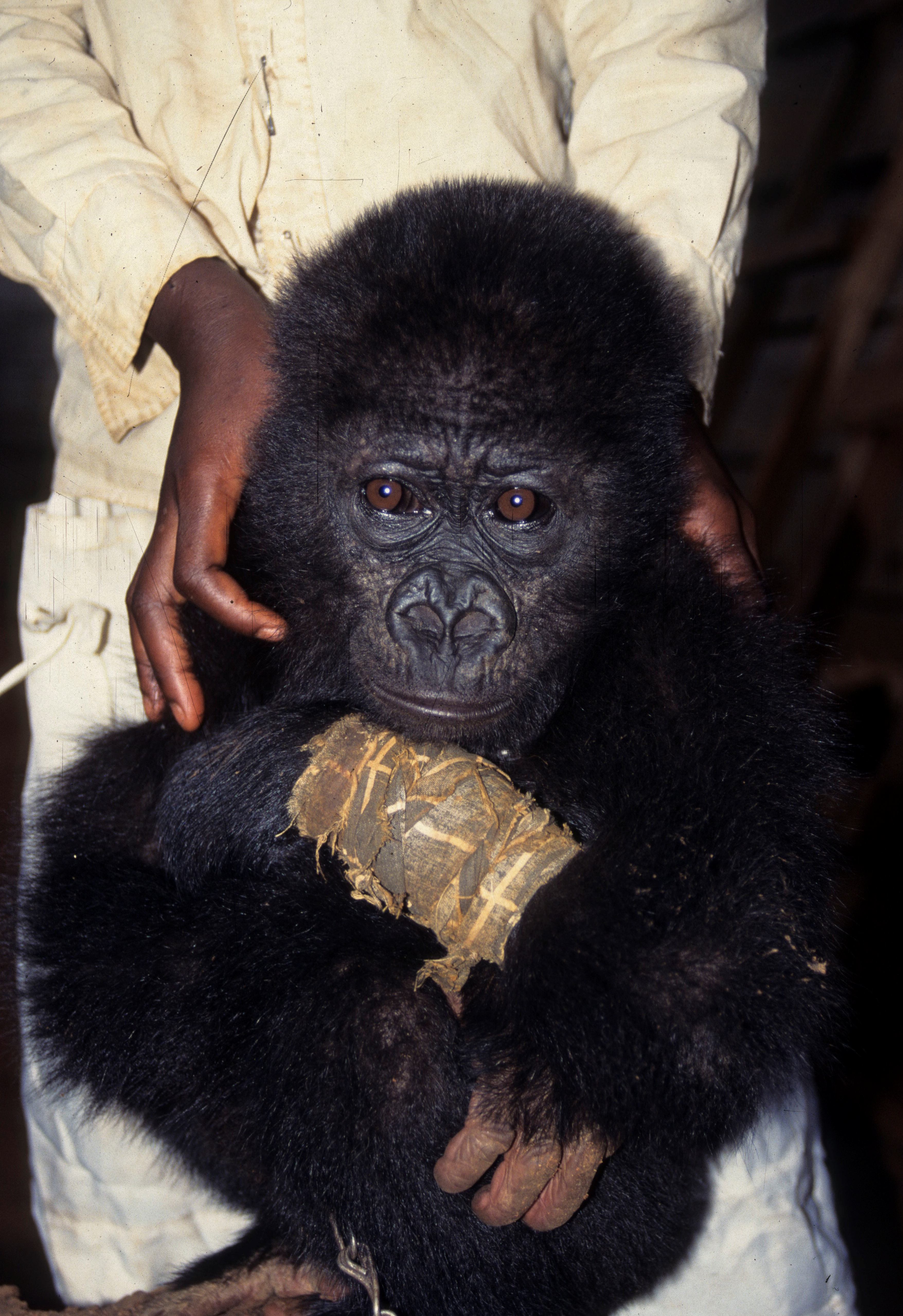
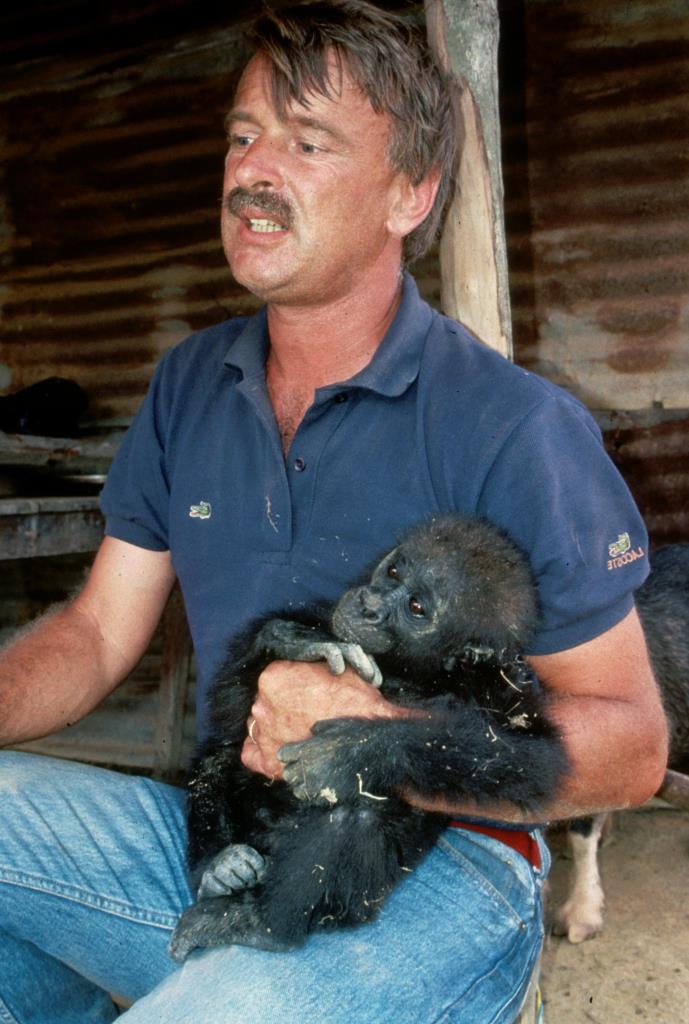
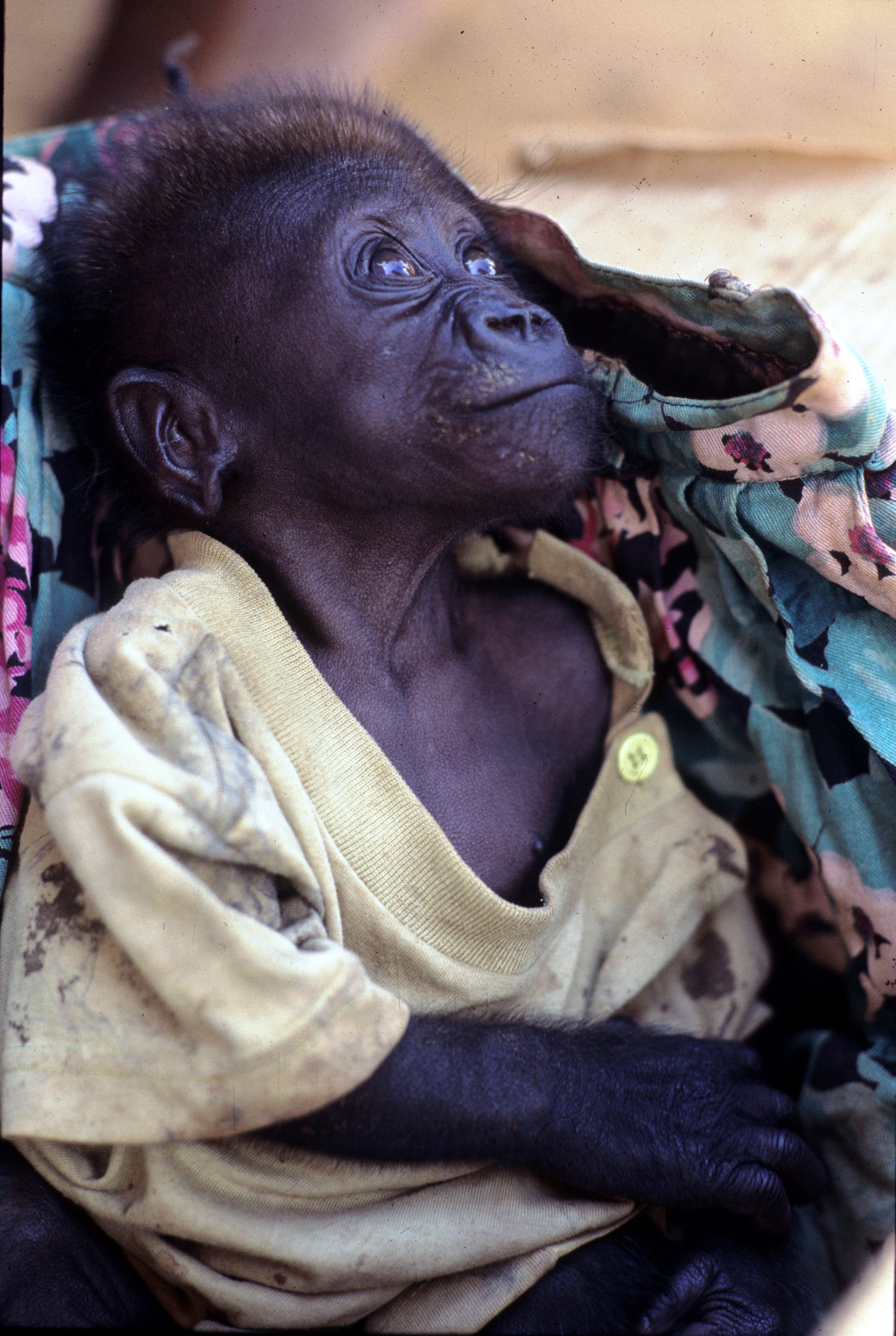
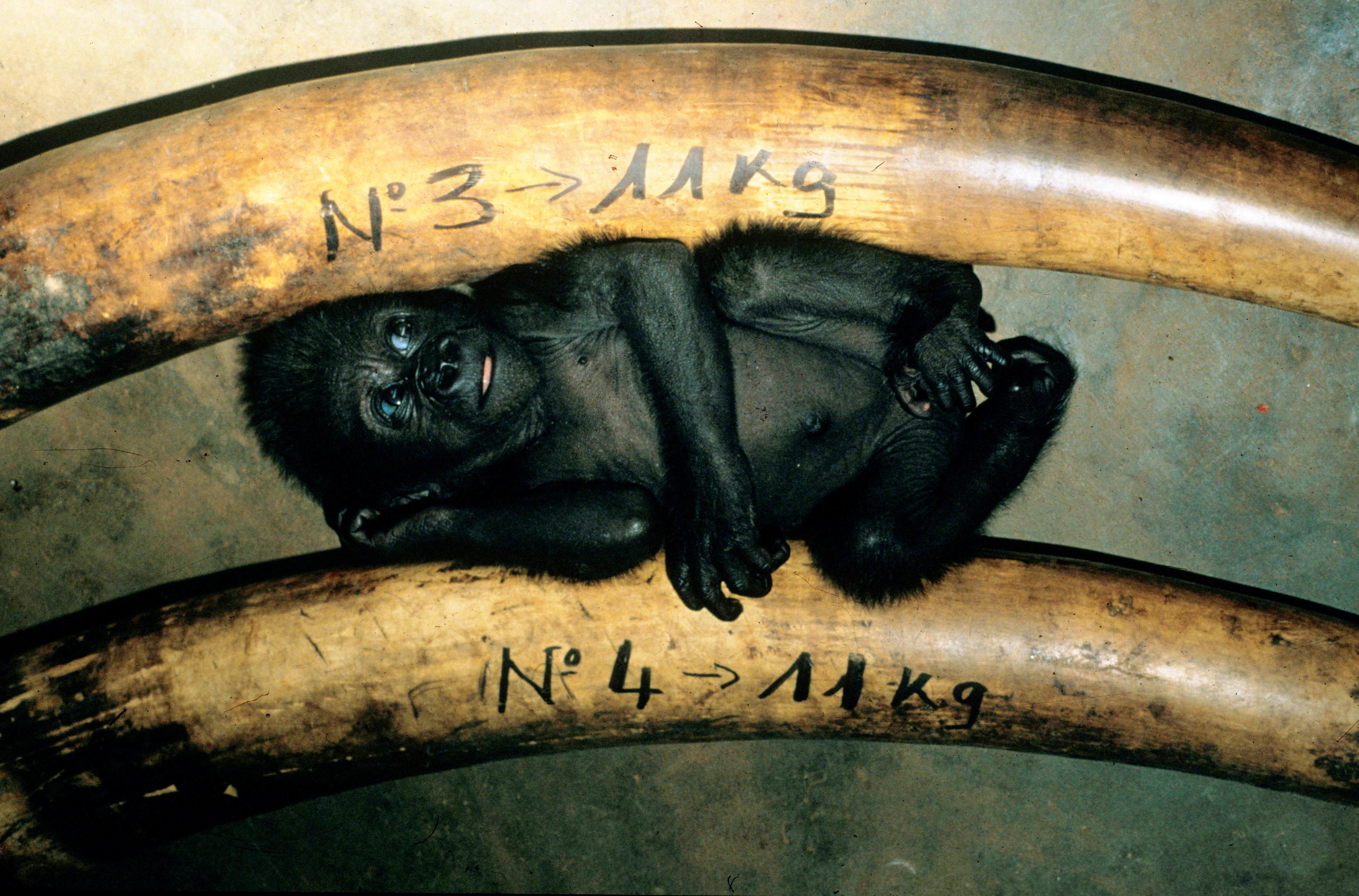
When I asked how they would obtain the animals, they admitted that, aside from one sanctuary, there were no captive gorillas in the DRC and that sanctuary animals were inaccessible. Their plan was to capture wild gorillas using nets—something previously done at scale with chimpanzees for vaccine research, as documented in Ed Hooper’s The River. When I asked where the nets would come from, they explained that they already had them at Kinshasa Zoo, donated by a European conservation/welfare organization. The zoo had requested them due to frequent chimpanzee escapes and was also supplied with a net gun. To my knowledge, no such gorilla capture operation has ever been attempted. All traded orphans then—and now—are accidental by-products of the bushmeat trade. I personally transported six such orphans to sanctuaries in Cameroon and Congo (see attached image).
6. The first artistic depiction of the charging silverback is also entirely unrealistic. At that point, hunters would have had their guns shouldered, not casually held at belt level. The cameraman who shot the second camera for Gorillas in the Mist needed charging footage and had trackers tie bamboo sticks together to strike the silverback from a relatively safe distance. When the animal charged, he went for the cameraman and bit him badly in the leg, requiring evacuation to Kenya from Bukavu.
7. Regarding the claim that Bili was to be moved from Libya to Dubai: “To move Bili to Dubai, the trafficker suggested they could transport her to Libya, then load her onto a Turkish Airlines flight bound for the United Arab Emirates.”
If the buyer was indeed a Sheikh in Dubai, Libya as a transit point might make sense. Much of today’s ape trafficking follows the overland desert route from Mali to Libya and then Egypt (four bonobos are reportedly due via this route before the end of Ramadan). However, Turkish Airlines does not operate direct flights from Libya to the UAE. No trafficker would introduce additional transit points and controls with additional X-ray checks. A Libya–Istanbul leg would have been required, followed by onward travel to Dubai—significantly increasing scrutiny at both exit and entry points. (see Cairo Connection, link below)
Notably, a subsequent gorilla trafficked from Kano to Lagos and then onward to Bangkok via Istanbul was confiscated. Again, it was a Cameroonian gorilla, and again there was a campaign for repatriation to Cameroon or another range-country sanctuary. Once more, the Turkish party involved resisted, and authorities failed to enforce CITES regulations—hardly helped by the fact that the PASA-accredited Pandrillus sanctuary continues to retain Bili.
8. From what I heard at the time, the gorilla in Lagos was temporarily housed with a local veterinarian while decisions were made regarding her destination. There was no attempt at DNA analysis, nor any serious effort to return her to an appropriate range-country facility.
9. The statement that “without the intervention of wildlife activists, Bili most likely would have been sold to a private zoo in the Middle East, China or elsewhere” omits the new Indian facility, which now reportedly holds over 60 chimpanzees, around 16 orangutans, and supposedly the only captive mountain gorilla outside the DRC. Plus I have Chinese dealers on camera telling me they had an order, some three years ago, from an Indian client willing to pay U$ 1 million per ape. This operation currently represents the largest source of demand for orphaned apes.
10. One final question remains: what is the status of the traffickers who brought Bili to Lagos? Where are they now—back in Kano? What activities are they currently engaged in? This is the enduring reality of the bushmeat and wildlife trade: very few offenders are ever held accountable, reinforcing the conclusion that this is a business with high rewards and minimal risk—particularly in Central and West Africa.
Overall, the research for this story would have benefited from deeper fact-checking with field biologists who work directly on bushmeat issues in Central and West Africa. There is no shortage of desktop researchers relying heavily on internet-derived material, which can be deeply misleading.
As a final anecdote:
A few years ago, I attended an ape conservation workshop in Florida with Jane Goodall. One morning, we visited the local zoo just as the gorillas were being released from their night enclosure. The silverback emerged at speed, ran straight to a freshly planted young banana tree, and began tearing into it. When we spoke to the keepers, they explained that new banana plants were planted each night so the gorillas would have something to engage with when they came out.
Later, I said to Jane that if we could ask these apes a simple question—whether they would choose this life, with abundant food and a stable family unit, or life in the forests of southeast Cameroon, surrounded by hundreds of hunters firing daily at anything that moves—I wasn’t sure the answer would be as obvious as many assume. She simply shrugged.
Regards
Karl Ammann
Links:
Book Eating Apes,
Book: Consuming Nature
Image of killed Gorilla family
CNN story: CNN Gary Steiker & KA R Leakey R Hayes slaughtered gorilla family
Video: Cairo Connection
 The world of Karl Ammann